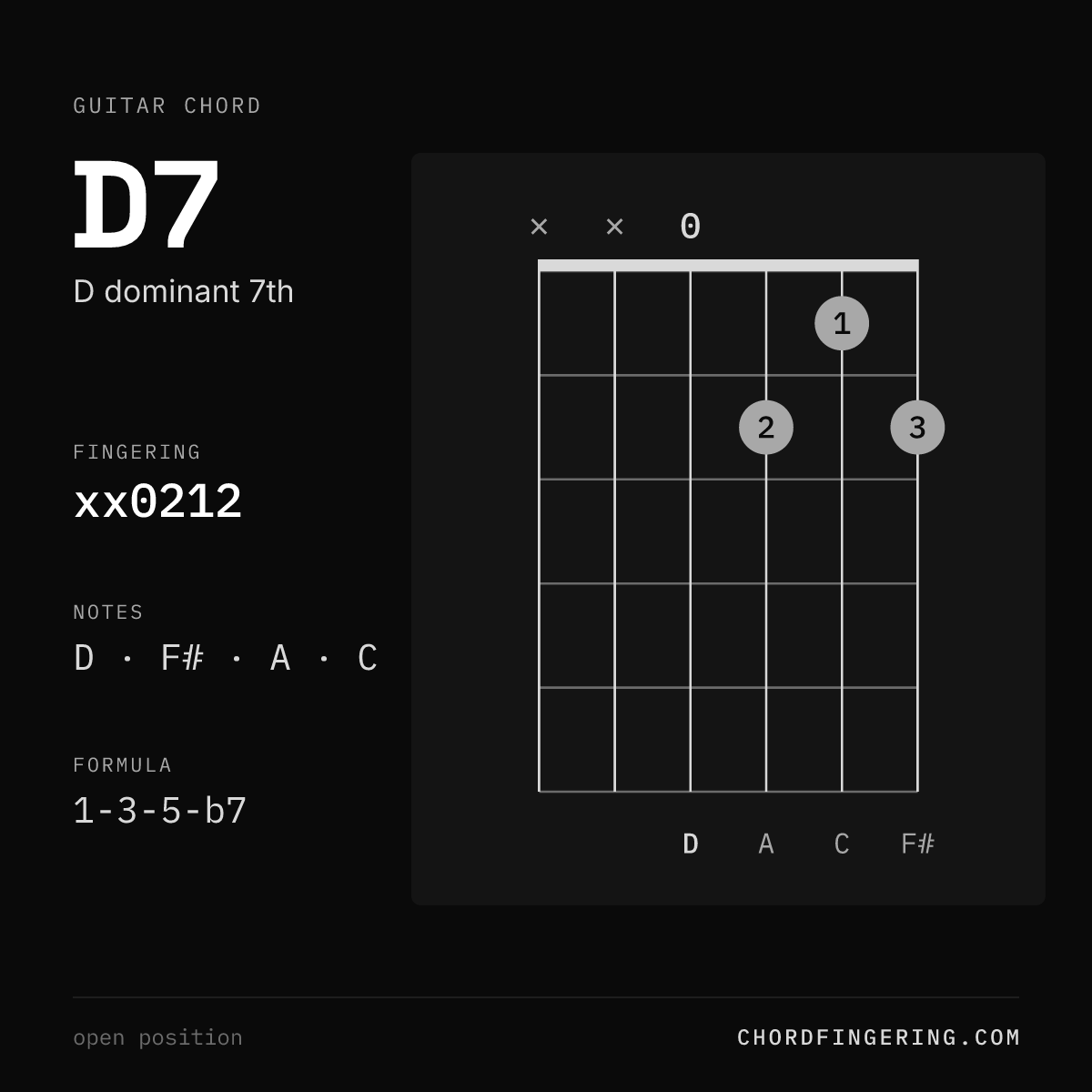
D7 open chord (xx0212)
- Fingering
- xx0212
- Fingers
- – – – 2 1 3
- Difficulty
- Easy
- Position
- open position
D dominant 7th · Ddom7 · D seventh
The D7 guitar chord is played xx0212 in open position. Its notes are D, F#, A and C.
The D7 chord is made of D · F♯ · A · C. Its formula is 1–3–5–♭7.
| Note | Degree | Interval from D |
|---|---|---|
| D | 1 | root |
| F♯ | 3 | major third |
| A | 5 | perfect fifth |
| C | ♭7 | minor seventh |
Second finger on the 2nd fret of the G string, first finger on the 1st fret of the B string, third finger on the 2nd fret of the high E string. The D string rings open.
It is the D triangle turned upside down: the point is now toward the nut. Strum the top four strings.
The first finger on the B string plays C, the note that turns D into D7. If it is muted by the fingers either side, you will hear a thin D chord instead.
D7 has 2 barre shapes here: 557575 (barre at the 5th fret) and 10-12-10-11-10-10 (barre at the 10th fret).
A barre shape has no open strings, so it moves. Slide any of them up one fret and you are playing D#7 (Eb7).
The open D7 chord is xx0212. It uses the open D string, which is why it rings longer than the shapes higher up the neck.
Chord names only, as the songs are usually charted for guitar. Recordings may use a capo or another key.
D7 is the V chord in G major. In minor keys it is the VII chord in E minor.
Play xx0212, reading from the low E string to the high E string. An x means the string is not played and a 0 means it rings open. The fingers used are - - - 2 1 3.
The D dominant 7th chord has 4 notes: D, F#, A and C. Its formula is 1–3–5–♭7, counted from the D major scale.
D7 is the V chord in G major. In minor keys it is the VII chord in E minor.
Printable D7 chord PDF (one letter page, black on white) · D7 chord PNG (1200 px)